
Why Accurate Commercial Cleaning Estimates Matter
Winning a commercial cleaning contract is only half the battle; pricing it correctly is what actually protects your margins. Underestimate the job, and you’ll be working for free by month three. Overestimate it, and a competitor with a tighter number walks away with the client. A solid estimate isn’t a guess; it’s a calculation built from square footage, labor time, supply costs, and a clear-headed profit margin.
Key Factors That Affect Commercial Cleaning Costs
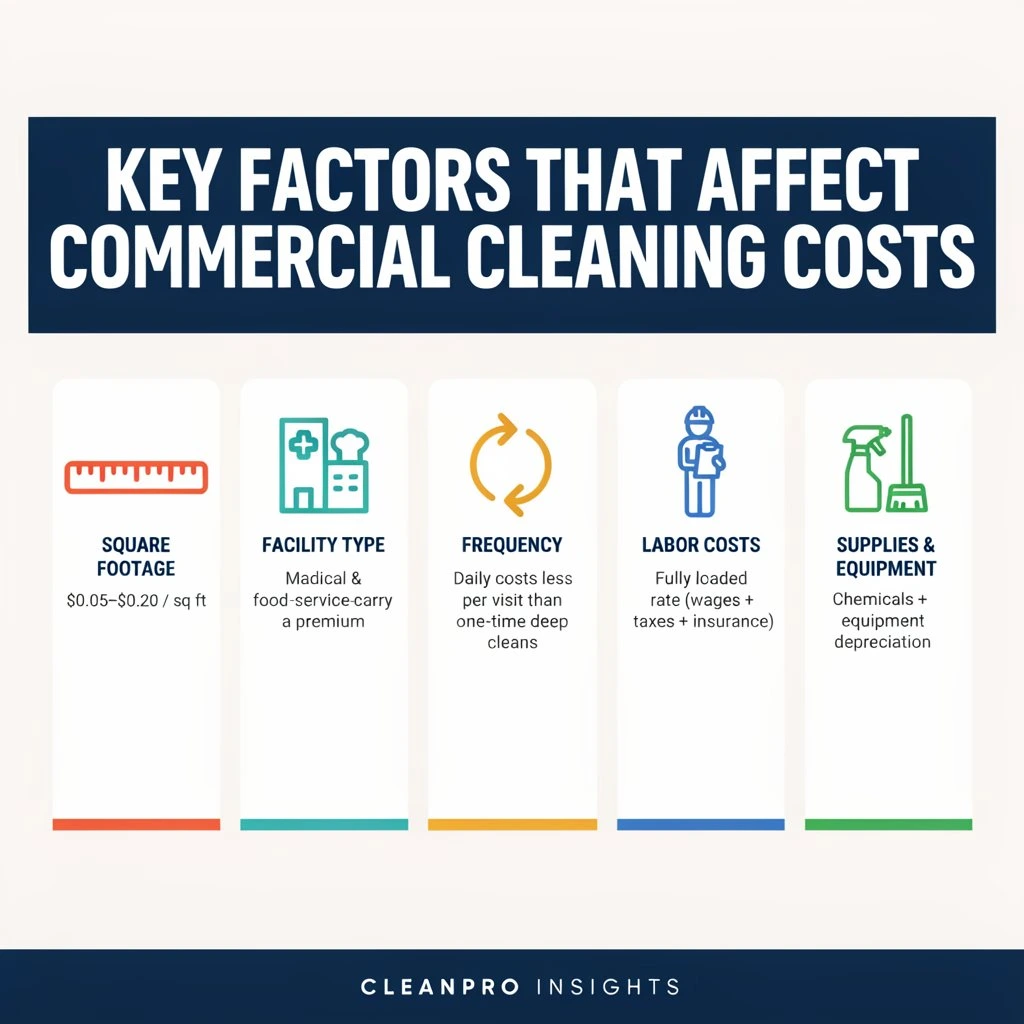
Square Footage. This is the backbone of almost every commercial cleaning quote. Most cleaning companies price somewhere between $0.05 and $0.20 per square foot, depending on the type of facility and how often it needs service, though specialized spaces (medical, industrial) run higher.
Facility Type. An office suite, a medical clinic, a warehouse, and a restaurant kitchen all take dramatically different amounts of time and different supplies to clean. Medical and food-service spaces typically carry a premium because of sanitation standards and liability.
Frequency of Service. Daily service costs less per visit than a one-time deep clean because you’re spreading fixed costs (travel, setup) across more visits, and the space stays maintained rather than needing to be reset from scratch each time.
Labor Costs. Your local labor market drives this more than anything else. Calculate a fully loaded hourly rate, wages, payroll taxes, insurance, and benefits, not just the number on the paycheck.
Supplies & Equipment. Chemicals, paper products, and equipment depreciation (vacuums, floor buffers, pressure washers) need to be baked into your rate, not treated as an afterthought.
Step-by-Step: How to Estimate a Commercial Cleaning Job
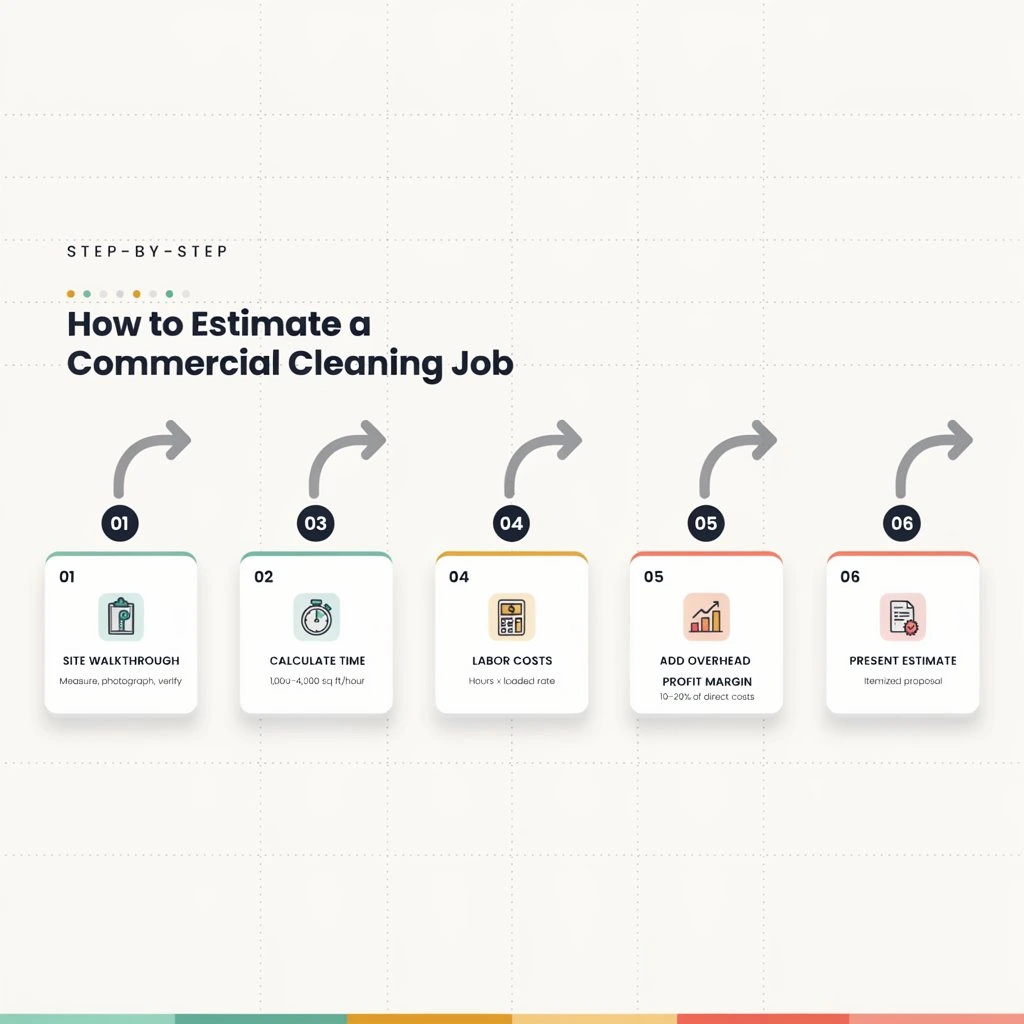
Step 1: Conduct a Site Walkthrough. Walk the entire space with the decision-maker. Note flooring types, restroom counts, high-traffic areas, glass surfaces, and any specialty areas (server rooms, labs, break rooms). Take photos and rough measurements; don’t rely on the client’s stated square footage without verifying it.
Step 2: Calculate Cleaning Time. Break the space into zones and estimate cleaning time per zone based on your team’s average productivity rate (a common industry benchmark is roughly 1,000–4,000 sq. ft. per hour, depending on task complexity). Multiply by the number of cleaners you’ll deploy.
Step 3: Determine Labor Costs. Multiply total labor hours by your fully loaded hourly rate. This is your direct cost of doing the job.
Step 4: Add Overhead. Overhead includes rent, insurance, admin staff, vehicle costs, and supplies, costs that exist whether or not this specific job runs. A typical overhead allocation for cleaning businesses falls between 10–20% of direct costs.
Step 5: Add Profit Margin. After labor and overhead, apply your margin, commonly 10–30% depending on market competitiveness and how much value-add (specialized certifications, guarantees, 24/7 response) you’re bringing.
Step 6: Present a Professional Estimate. Break the estimate into a clear scope of work, frequency, pricing structure, and terms. A vague one-line number looks amateurish next to a competitor’s itemized proposal, and itemization also protects you if the client later tries to add scope without paying for it.
Common Commercial Cleaning Pricing Models
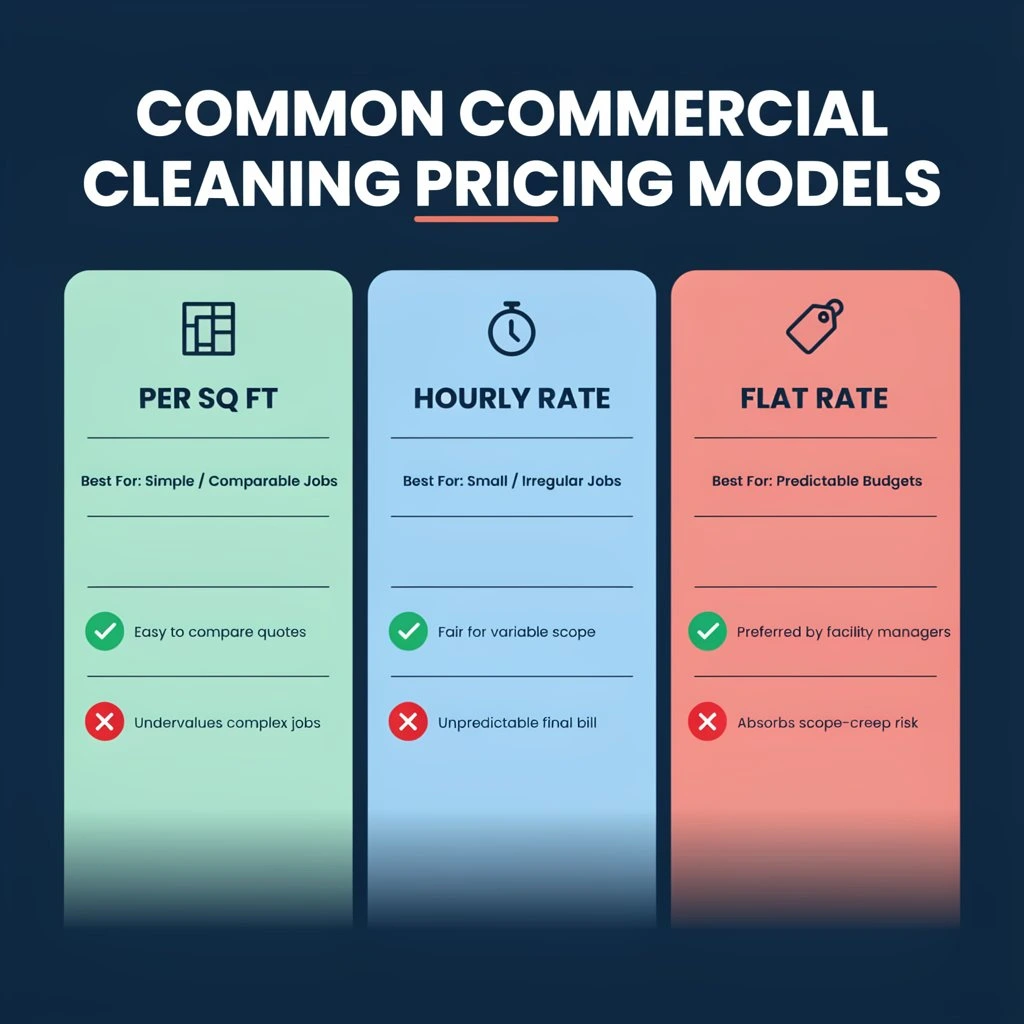
Per Square Foot. Simple, transparent, and easy for clients to compare across bids, but it can undervalue jobs with unusual complexity (heavy machinery, biohazard protocols).
Hourly Rate. Works well for smaller or irregular jobs, but clients sometimes dislike the unpredictability of the final bill.
Flat Rate. Preferred by most facility managers because it’s predictable. Requires the most accurate upfront estimating since you’re absorbing the risk of scope creep.
Common Mistakes to Avoid When Estimating
- Skipping the site visit and pricing off a floor plan alone, square footage on paper rarely matches real-world clutter, layout, and condition.
- Forgetting supply costs for chemicals and equipment wear.
- Underpricing to win the bid, then trying to claw back margin later with add-on fees, damages trust.
- Not accounting for access restrictions, after-hours work, security clearances, and limited elevator access all add time.
Why Professional Estimating Support Wins More Bids
This is where a dedicated construction estimating expert, with experience across facility and commercial project types, can help: producing detailed, defensible, professionally formatted estimates quickly, so your team spends less time on spreadsheets and more time on the jobs you’ve already won.
FAQs
How do I estimate a commercial cleaning job without seeing it in person? It’s possible using floor plans and photos, but accuracy drops significantly. A phone consultation plus photos/video walkthrough is the minimum for a reliable quote.
What’s a fair profit margin for commercial cleaning? Most established commercial cleaning businesses target a 10–28% net margin after all costs, though this varies by region and service type.
Should I charge more for a first-time deep clean vs. recurring service? Yes, a first clean typically requires 1.5–3x the time of a recurring visit because the space hasn’t been maintained to your standard yet.
Conclusions
A commercial cleaning estimate is a calculation, not a hunch. Nail down square footage, labor time, overhead, and margin in that order, and you’ll consistently price jobs that are both competitive and profitable.